
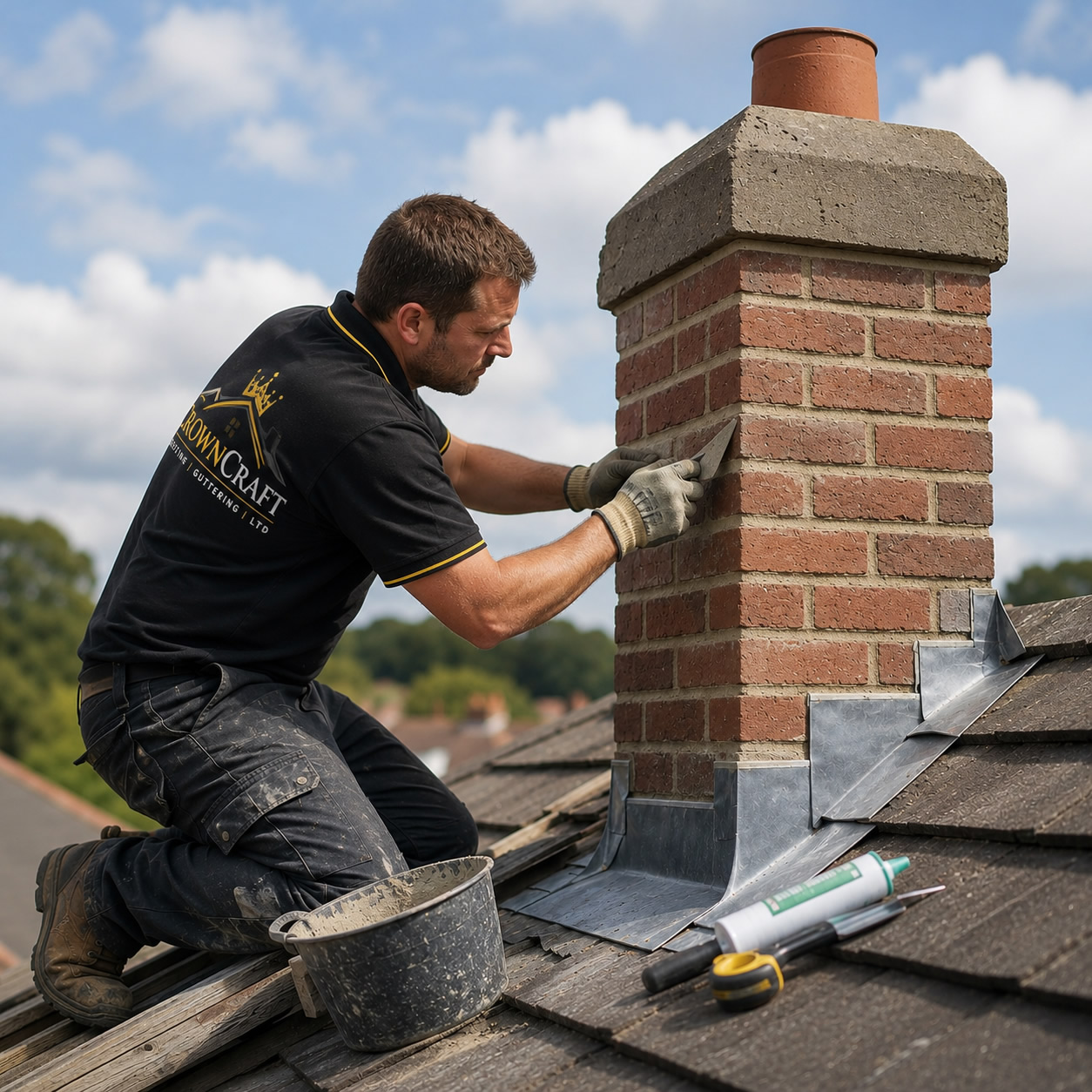
Chimney Repairs
Chimney repointing, lead flashing, flaunching, cowls, pots, stack repairs and chimney leak investigation.
Complete Chimney Repair Services
From leaking chimney flashings and crumbling mortar to damaged pots, failed flaunching and unstable stacks, CROWN CRAFT ROOFING AND GUTTERING LTD provides practical chimney repairs designed to protect the roof, the structure below and the inside of the property.
Professional chimney repairs carried out as part of the roof system
A chimney is one of the most exposed parts of a property. It sits above the roofline and is constantly affected by rain, wind, frost, salt air, temperature changes and movement. Small defects around the stack can allow water to track behind tiles or slates, soak roof timbers and appear as damp staining inside the loft or upper rooms.
Our chimney service looks beyond the visible symptom. We assess the stack, mortar joints, leadwork, flaunching, pots, cowls, surrounding tiles or slates and the point where the chimney meets the roof. This helps identify whether the problem is caused by failed pointing, defective flashing, cracked flaunching, damaged masonry or a combination of issues.
Chimney services we provide
- Chimney leak investigation and fault tracing
- Chimney stack repointing and mortar-joint renewal
- Lead apron, step flashing and back-gutter repairs
- Lead soaker replacement beneath tiles or slates
- Flaunching repairs and complete flaunching renewal
- Chimney pot replacement and secure re-bedding
- Chimney cowl, cap and bird-guard installation
- Localised brick replacement and stack stabilisation
- Storm-damage repairs around chimney stacks
- Partial or complete chimney removal where appropriate
Problems we commonly repair
- Damp patches near chimney breasts or ceilings
- Water entering around the chimney base
- Loose, cracked or missing mortar joints
- Split, lifted or poorly fitted lead flashing
- Cracked flaunching around chimney pots
- Loose or damaged pots and cowls
- Spalled, cracked or weathered chimney bricks
- Open joints where the stack meets the roof covering
- Debris falling from an ageing chimney
- Damage following strong winds or prolonged rain
Chimney repointing
Mortar joints protect the chimney masonry and help keep the stack stable. Over time, exposed mortar can crack, wash out or become soft and powdery. Once joints open, rainwater can penetrate deeper into the stack and frost can accelerate the deterioration.
Where appropriate, defective joints are carefully removed and renewed with a suitable mortar. The aim is to restore weather resistance while avoiding unnecessary disturbance to sound brickwork.
Lead flashing and soakers
The leadwork around a chimney forms a critical weatherproof junction between the stack and the roof covering. Apron flashing protects the front, step flashing and soakers protect the sides, and the back gutter manages water flowing from the roof above the chimney.
Loose, split or poorly dressed lead can allow water beneath tiles or slates. We can repair isolated defects or replace the relevant lead details when the existing material is no longer serviceable.
Flaunching and chimney pots
Flaunching is the sloping mortar bed at the top of the chimney. It secures the pots and helps shed rainwater away from the openings. Cracked or hollow flaunching can allow water into the top of the stack and may leave pots unstable.
Depending on condition, we can repair local defects or renew the flaunching around the pots. Loose, cracked or damaged pots can also be re-bedded or replaced as part of the same work.
Cowls, caps and bird guards
Suitable terminals can help reduce rain entry, prevent birds or debris entering an unused opening and improve protection at the top of the stack. The correct product depends on whether the flue remains active, ventilated or disused, so the intended use must be established before installation.
How we approach a chimney leak
- Initial enquiry: We gather details about where and when the damp appears, recent weather and any previous repairs.
- External assessment: The chimney stack, mortar, leadwork, flaunching and nearby roof covering are inspected.
- Likely water path: We consider how rain may be entering and travelling beneath the visible roof surface.
- Repair recommendation: The required work is explained clearly, including any related roof defects.
- Weatherproof repair: Defective materials are repaired or replaced using details suited to the roof.
- Surrounding roof checks: Nearby slates, tiles, ridges and valleys are checked where relevant.
- Final inspection: Completed work and roof junctions are reviewed before the area is left tidy.
- Aftercare: Any sensible maintenance or future monitoring is explained to the customer.
Repairing the chimney can protect more than the stack
Water entering around a chimney may damage underlay, battens, roof timbers, insulation, plaster and internal decoration. Early repair can reduce the risk of a relatively contained defect becoming a larger roofing and internal-damp problem.
- Helps stop water entering around the chimney base
- Protects nearby tiles, slates, battens and underlay
- Reduces the risk of damp affecting roof timbers
- Improves the stability of pots and exposed masonry
- Restores a cleaner, better-maintained roofline
- Can prevent repeated patch repairs to the same leak
Repair, rebuild or removal?
Many chimney problems can be resolved with targeted repointing, flashing, flaunching or pot repairs. More extensive rebuilding may be needed where masonry is severely weathered, the stack has become unstable or previous repairs have failed across a wide area.
For redundant chimneys, partial or complete removal may sometimes be considered. Chimney removal can affect the roof structure, party-wall arrangements, ventilation and building-control requirements, so it must be properly assessed and agreed before work begins.
CROWN CRAFT ROOFING AND GUTTERING LTD will recommend the most practical roofing solution based on the visible condition, access, roof type and intended future use of the chimney.
Chimney repair questions
How do I know whether the chimney is causing my leak?
Damp near a chimney breast, staining after wind-driven rain and moisture close to the chimney in the loft can indicate a fault. A proper inspection is needed because water can travel before becoming visible.
Can failed flashing be repaired without rebuilding the chimney?
Often, yes. Where the stack is sound and the defect is limited to the leadwork, the affected flashing or soakers may be repaired or replaced independently.
What is chimney flaunching?
It is the sloping mortar finish around the chimney pots at the top of the stack. It supports the pots and helps direct water away.
Do cracked mortar joints matter?
Yes. Open joints allow moisture into the masonry and can worsen through frost and repeated weather exposure.
Can you replace a damaged chimney pot?
Yes, subject to safe access and the condition of the stack and flaunching. The new pot must be suitable for the intended use.
Will repointing stop every chimney leak?
No. The leak may also involve lead flashing, flaunching, roof coverings or condensation. The full junction should be checked.
Can a redundant chimney be capped?
A suitable cap or terminal may be possible, but ventilation requirements should be considered to avoid trapping moisture inside a disused flue.
Do you repair the roof around the chimney too?
Yes. Chimney repairs often involve nearby tiles or slates, underlay, battens, lead soakers and the back gutter.
Can storm damage make a chimney unsafe?
Strong wind can loosen pots, cowls, mortar or already weakened masonry. Keep clear of falling debris and arrange an inspection.
Is a scaffold always required?
Access depends on height, roof pitch, location and the work involved. Safe access is assessed for each property.
How long does chimney repair take?
Timescales vary from a focused flashing repair to more extensive repointing or rebuilding. The likely scope can be explained after inspection.
Can you inspect an older chimney before it starts leaking?
Yes. Preventive inspection can identify deteriorated joints, flaunching or leadwork before internal damage becomes visible.
Concerned about a leaking or damaged chimney?
Tell CROWN CRAFT ROOFING AND GUTTERING LTD what you have noticed and request a clear roofing assessment and quotation.
Chimneys Gallery
Scroll through photographs from our chimneys work.

Chimneys Videos
Scroll through project videos uploaded for this service.
Request a free chimney repair quote.
Tell us about the chimney, any visible damage and where you have noticed damp or water entry. CROWN CRAFT ROOFING AND GUTTERING LTD will receive the enquiry straight away.